Why We Build
Green Goods exists because regenerative communities deserve better tools. Field workers plant trees, collect waste, maintain solar panels, and teach – but their impact often goes undocumented, unverified, and unfunded. We're building the infrastructure to change that.
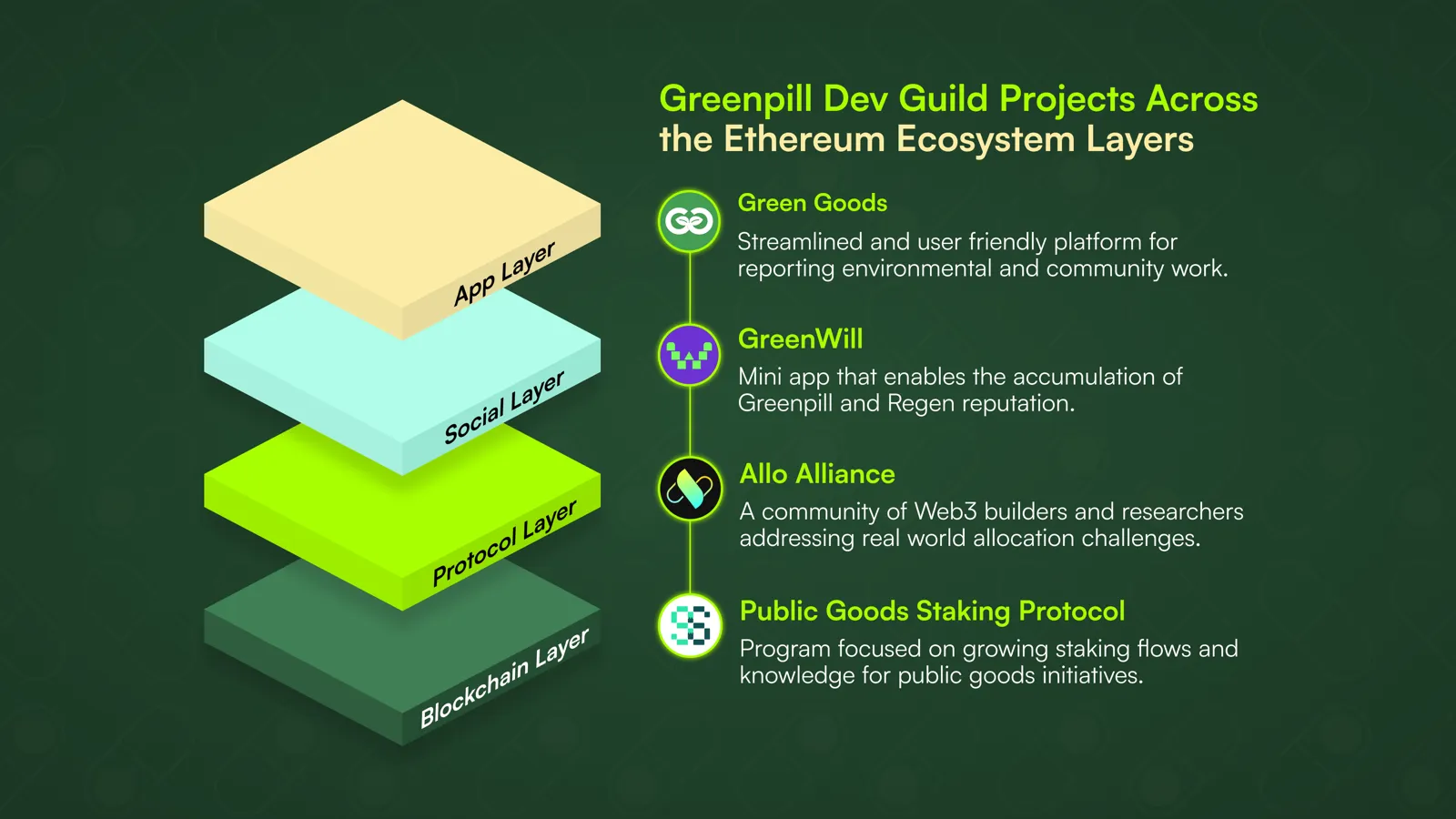
Greenpill & Regen Core
Green Goods is built by the Greenpill Dev Guild, a collective of developers and designers whose mission is to foster positive-sum actions where impact = profit.
Greenpill Dev Guild Mission
The Greenpill Dev Guild builds open-source tools for regenerative communities. We believe that the people who create positive impact should be the ones who benefit from it – not intermediaries, not platform operators, but the gardeners, waste collectors, and community organizers doing the work.
Our core services:
- Platform development – Building and maintaining the Green Goods protocol
- Community onboarding – Helping garden operators set up and manage their communities
- Impact methodology – Designing action schemas and assessment frameworks
- Integration support – Connecting to funding mechanisms (Hypercerts, Octant, Gardens)
- Localization – Adapting the platform for communities across languages and regions
Greenpill Ethos
The Greenpill movement asks a simple question: What if we used coordination technology to create abundance rather than extract it? Green Goods answers this by connecting real-world regenerative work to on-chain verification and capital – making impact legible, fundable, and sustainable.
Every feature decision is evaluated against this ethos:
- Does it create more value than it consumes?
- Does it empower communities or create dependencies?
- Does it reduce barriers for field workers?
- Does it increase transparency for funders?
The Regen Movement
Green Goods is part of a broader ecosystem of regenerative builders who believe technology should serve ecological and social renewal. We build on open protocols (EAS, Hats, Hypercerts) rather than proprietary infrastructure. We share learnings publicly. We iterate based on feedback from the gardeners in Cape Town and the agroforesters in Brazil – not abstract personas.
Our work maps to these United Nations Sustainable Development Goals:
| SDG | Connection |
|---|---|
| Good Health & Well-Being (3) | Community gardens improve food security and nutrition |
| Clean Water & Sanitation (6) | Watershed protection and water system maintenance |
| Affordable & Clean Energy (7) | Solar infrastructure monitoring and maintenance |
| Sustainable Cities & Communities (11) | Urban greening, waste management, community spaces |
| Responsible Consumption & Production (12) | Waste reduction, recycling, circular economy actions |
| Life on Land (15) | Reforestation, agroforestry, biodiversity monitoring |
Create Stronger Local Economies
Regenerative work shouldn't depend on perpetual grant funding. Green Goods creates the infrastructure for communities to build their own sustainable economies around verified impact.
Bringing Accessible Tools To Communities
Most impact reporting tools are built for NGOs with dedicated staff and reliable internet. Green Goods is built for the opposite reality:
- Offline-first – Works without internet. Submissions queue locally and sync when you're back online.
- No wallet needed – Sign in with your fingerprint or face. No seed phrases, no browser extensions.
- Multi-language – Full UI support in English, Spanish, and Portuguese. Additional languages are under consideration.
- Low bandwidth – Designed for mid-range Android devices on 2G/3G networks.
- Under a minute – From first visit to first submission in less than 60 seconds.
These aren't nice-to-have features – they're requirements driven by the real constraints of 20+ active garden communities across Latin America, Africa, and North America.
Making Funding Accessible
The biggest challenge for regenerative communities isn't doing the work – it's proving the work happened and connecting that proof to funding. Green Goods solves both:
- Evidence capture is as simple as taking a photo with the MDR workflow
- Community verification creates permanent, on-chain attestations
- Impact certification aggregates verified work into Hypercerts
- Capital formation flows through impact vault deposits, harvest routing, and Hypercert purchases
Vault deposits are designed so depositor claim value stays flat. When strategies generate yield, Green Goods routes that yield through harvest and split flows into community funding rather than depositor share-price appreciation.
The result: a field worker in Nigeria can photograph their solar panel maintenance, get it verified by their campus operator, and have that verified work attract real capital from funders anywhere in the world.
Connecting Communities To Their Bioregions
Green Goods organizes impact around action domains that map to local ecological contexts:
- An agroforestry garden in Brazil tracks tree plantings, canopy cover, and harvest yields
- A waste management garden in Cape Town tracks kilograms diverted from landfill
- A solar infrastructure garden in Nigeria tracks kWh generated and panels maintained
- An education garden in Kenya tracks participants engaged, curricula completed, and knowledge assessments
Each domain has its own impact metrics, but all feed into the same verification and funding pipeline. Communities document what matters to their bioregion, and the platform handles the rest.
Care for Living Systems
At its core, Green Goods is driven by a simple motivation: care for the living world and the communities that steward it.
Why This Work Matters
Technology is a means, not an end. Every protocol integration, every smart contract, every UI component exists to serve one purpose: making it easier for people to do regenerative work and be recognized for it. The dignity of small work – planting a single tree, collecting a bag of trash, maintaining a solar panel – is what Green Goods is built to honor.
Regeneration Takes Many Forms
Green Goods communities show us that regenerative work takes many forms:
- Community educators in Kenya run public-goods and sustainability programs while documenting what participants actually learn and apply
- Waste collectors in Cape Town clean their neighborhoods while earning community credits
- Agroforesters in Brazil generate scientific datasets alongside their practical fieldwork
- Solar teams in Nigeria keep critical infrastructure running for their campus community
Each of these connections is valuable, measurable, and fundable – when the right tools exist to capture them.
A Holistic View of Value
The relationship between humans and nature is richer than any single metric. Green Goods captures this richness through the Eight Forms of Capital — a holistic framework that looks beyond financial returns to measure the full spectrum of value that regenerative work creates.
Eight Forms of Capital
The forms listed below are examples, not an exhaustive taxonomy; communities may identify additional dimensions of value specific to their bioregion and culture.
By measuring all eight forms, Green Goods ensures that regenerative work is valued holistically -- a tree planted isn't just carbon sequestered, it's also food security, biodiversity, community engagement, and educational opportunity.
Next page
Next: Where We're Headed
Now that you understand why we build, see the strategic goals, roadmap, and partnerships driving Green Goods forward.
Where We're Headed