Managing Governance
Overview
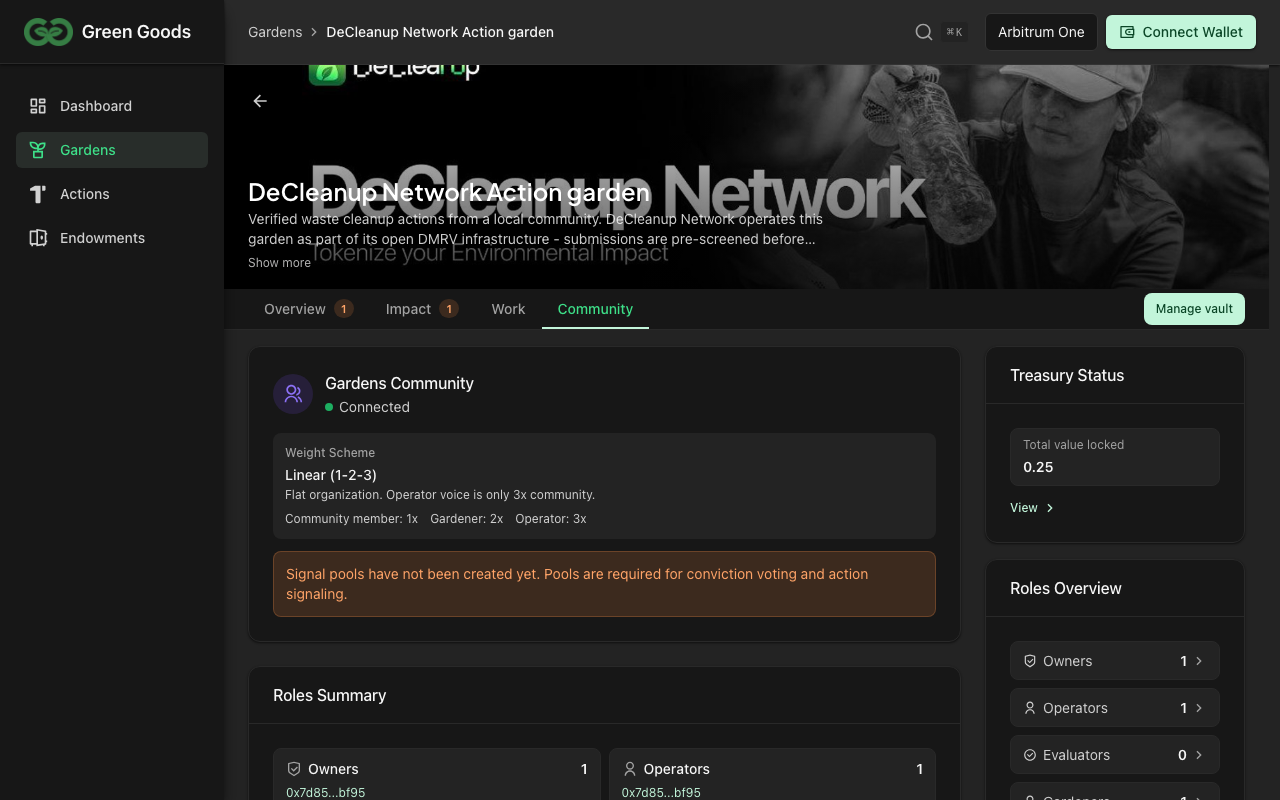
Conviction voting and signal pools give your garden community a voice in resource allocation. Signal pools let members express preferences on which hypercerts or initiatives should receive funding, while conviction strategies apply time-weighted voting mechanics to turn signals into binding decisions.
Routes and hooks
Strategy and signal-pool routes are live in admin and supported by conviction hooks in shared.
Chain readiness
In progressThe governance module is deployed on Arbitrum, but creating a signal pool also needs an initialized community and pool configuration that are not in place for every garden yet. Check with the team before planning a pool on any network.
How It Works
- 1
Configure strategy
Set conviction strategy addresses and role hat IDs in the Strategies tab. Define how voting power is calculated and distributed.
- 2
Create pools
Create signal pools for selected weight schemes. Each pool can target different allocation decisions.
- 3
Register hypercerts
Register or deregister eligible hypercert claims for signaling. Only registered claims can receive votes.
- 4
Allocate support
Community members stake their voting power on preferred claims. Track conviction changes over time as support accumulates or shifts.
Pick a governance path
If: You need directional preference before endowment commitment
Do: Start with signal pools and monitor participation.
Then: Promote high-signal items to formal allocation decisions.
If: You need weighted, time-based conviction dynamics
Do: Use conviction strategy with explicit power registry inputs.
Then: Review role mappings and anti-capture controls before launch.
If: You need immediate discretionary funding
Do: Use cookie jars or operator-approved endowment actions.
Then: Reserve conviction for longer-horizon governance.
Best Practices
- Start with signal pools to gauge community preferences before committing to full conviction voting
- Clearly communicate to your community how voting power is calculated (role-based, stake-based, or equal)
- Review role mappings and anti-capture controls carefully before launching conviction strategies
- Monitor participation rates — low participation can lead to outcomes that don't reflect broad community preferences
- Use signal pools for advisory governance and conviction voting for binding allocation decisions
What's Next
Next page
Next best action
With governance configured, track and report your garden's impact.
Reporting and GAP